
V2L explained: How your EV can power devices
Key takeaways
- V2L turns a compatible EV into a mobile power source.
- It can power appliances at home during blackouts and equipment on road trips, camping adventures and caravanning holidays.
- Common uses include running fridges, charging devices, powering lights and operating small appliances.
- Drivers should monitor battery levels, as using V2L can affect driving range.
- A growing number of EVs sold in Australia now offer V2L capability.
One of the lesser-known features available in some electric vehicles (EVs) is Vehicle-to-Load (V2L) technology, which allows owners to use their car's battery to power external appliances and devices.
While V2L is often associated with camping and road trips, it can also provide backup power for household appliances during a blackout. From keeping a fridge running during a power outage to charging e-bikes at a campsite, V2L can transform an EV into a mobile power source.
For Queensland motorists, that means the same technology that can power a camping fridge on a weekend getaway could also help keep essential appliances operating at home when severe weather disrupts electricity supplies.
What is Vehicle-to-Load (V2L)?
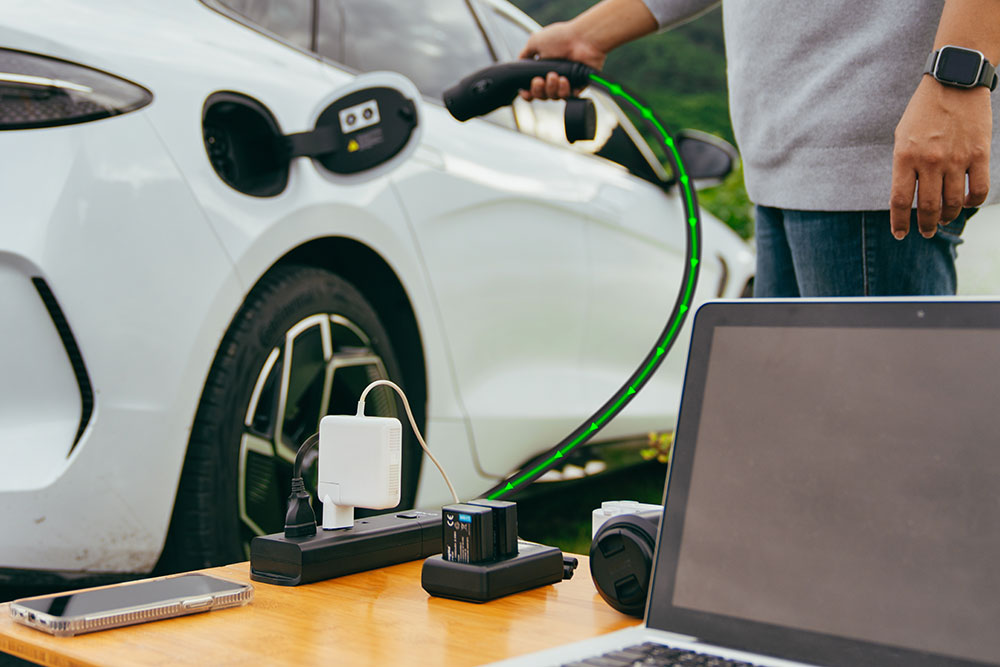
V2L technology allows electricity stored in an EV's high-voltage battery to be used to power compatible external devices.
Rather than using energy solely to drive the vehicle, V2L can supply power to a wide range of appliances, whether that's a coffee machine at a campsite, power tools on a worksite or essential household items during a blackout.
Depending on the vehicle, power may be supplied through an external charging-port adaptor or a dedicated household-style power outlet located inside the cabin, tray or cargo area.
How does V2L work?
V2L systems convert the battery's DC power into the same AC power used by common household appliances.Once activated, drivers can plug in compatible devices just as they would at home, subject to the vehicle's maximum power output limits.
This can include everything from laptops and power tools to electric cooktops and portable fridges.
Why is V2L useful?
V2L's biggest advantage is flexibility. It can power appliances wherever they're needed, whether that's at a remote campsite, on a worksite, at a community event or at home during a power outage.
For Queensland motorists, that means one vehicle can serve as both transport and a portable source of electricity.
Common road trip uses include:
- Running a camping fridge or freezer
- Charging phones, tablets and camera batteries
- Powering camp lights and portable fans
- Using a coffee machine or electric kettle
- Inflating paddleboards, kayaks and air mattresses
- Charging e-bikes and outdoor recreation equipment
- Operating a small induction cooktop or electric barbecue.
For travellers who regularly camp or caravan, V2L can effectively turn an EV into a large mobile power bank.
Drivers should always ensure enough battery capacity remains for planned travel, but the additional flexibility can offer peace of mind when exploring regional and remote areas.
Can V2L help in emergencies?
While V2L is often associated with camping and recreation, it can also provide backup power in unexpected situations.
For example, it may be used to charge essential household devices during a blackout, power emergency lighting at a campsite or provide temporary electricity if a caravan battery system fails.
V2L is designed to power individual appliances and devices. Powering an entire household electrical system generally requires dedicated Vehicle-to-Home (V2H) equipment and vehicle compatibility.
Does using V2L affect driving range?
Yes. Any electricity used to power external devices comes directly from the vehicle's battery, reducing the energy available for driving.
However, the impact varies depending on the appliance being used.
Charging phones, laptops and small electronic devices typically uses very little energy, while high-demand appliances such as heaters, air fryers and cooktops will draw significantly more power.
For road trips, it's worth monitoring battery levels and factoring V2L usage into charging plans, particularly when travelling in regional areas where charging locations may be further apart.
When will your vehicle stop powering your appliances?
It’s important to check how much battery your car needs to power your devices.
For some EVs you can also set a minimum battery discharge limit to make sure your EV has enough charge to get where you need to go.
Which EVs offer V2L?
An increasing number of EVs sold in Australia now offer V2L capability, including selected models from Hyundai, Kia, BYD, MG and Ford.
Availability, power output and outlet configurations vary between manufacturers, so buyers should check specifications before purchase.
The bottom line
While V2L may sound like a niche feature, it can add genuine practicality for Queensland motorists.
Whether it's brewing a morning coffee on Moreton Island, keeping a fridge running on a Cape York expedition or supplying power to essential household appliances during a blackout, V2L shows how an EV can do much more than simply get you from A to B.
As more V2L-capable EVs arrive in Australia, the technology is proving just as valuable in the driveway during a storm-related outage as it is at a campsite on a road trip.

More articles
Related topics
Things to note
The information in this article has been prepared for general information purposes only and is not intended as legal advice or specific advice to any particular person. Any advice contained in the document is general advice, not intended as legal advice or professional advice and does not take into account any person’s particular circumstances. Before acting on anything based on this advice you should consider its appropriateness to you, having regard to your objectives and needs.
Insurance Products (excluding Travel Insurance) are issued by RACQ Insurance Limited ABN 50 009 704 152 (RACQI) and arranged by RACQ Distribution Services Pty Ltd (RDS) ABN 35 116 361 650, AFSL 567130 and RDS' authorised representatives (including RACQ Operations Pty Ltd ABN 80 009 663 414, AR No. 234978 (RACQO)). Conditions, limits and exclusions apply.
Any advice provided by RDS and RACQO is general advice only and does not take into account your personal objectives, financial situation or needs and you will need to consider whether the advice is appropriate for you. Read the Product Disclosure Statement (PDS) before making a purchase decision on the product. You can also access our Target Market Determinations on this website.
RDS receives a commission from RACQI for the policies it arranges. RACQO receives fees paid for services it provides to RDS. Further details about remuneration are available on request prior to purchasing.
RACQ Operations Pty Ltd (ABN 80 009 663 414, AR No. 234978) and Members Travel Group Pty Ltd (ABN 45 144 538 803, AR No.432492) (RACQ) are authorised representatives of the RACQ Travel Insurance insurer Tokio Marine & Nichido Fire Insurance Co., Ltd. (ABN 80 000 438 291 AFSL 246 548) (Tokio Marine). Tokio Marine Management (Australasia) Pty Ltd (ABN 69 001 488 455, AR No. 1313066) is an authorised representative of Tokio Marine, and administers RACQ Travel Insurance as the managing agent on behalf of Tokio Marine. Terms, conditions (including eligibility criteria), exclusions, limits and sub-limits apply. Any advice is general advice only, and does not take into account your specific objectives, financial situation or needs. Before you purchase, please consider the Combined Product Disclosure Statement (PDS) / Financial Services Guide (FSG) and Target Market Determinations (TMDs) available at racq.com or on request from RACQ.